


24. Oktober 2026
"Mir wallen bleiwen wat mir sen". The Dialectic of Permanence: Why Tradition Asserts Itself Only Through Change
Der Artikel „,Mir wallen bleiwen wat mir sen.‘ The Dialectic of Permanence: Why Tradition Asserts Itself Only Through Change“ von Dr. Johann Lauer ist die Übersetzung in englischer Sprache des Artikels „,Mir wallen bleiwen, wat mir sen.‘ Die Dialektik der Beständigkeit: Warum sich Tradition nur im Wandel behauptet“, erschienen in der Siebenbürgischen Zeitung Online vom 15. Oktober 2026. Dedicated to the coming generations, so that our cultural heritage does not harden into ashes, but remains a living practice through our actions and theirs.
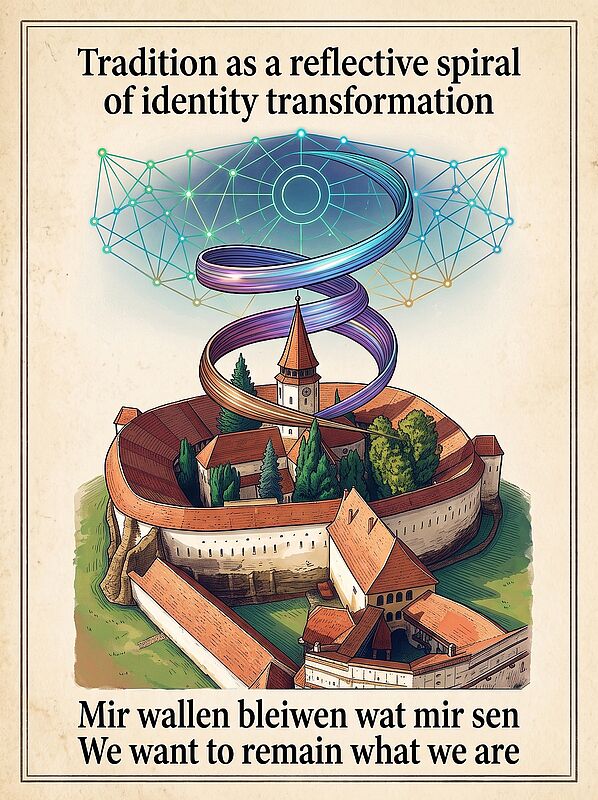
Graphic: AI-generated (Gemini)
A. A Sentence That Demands More Than It Promises
“We want to remain what we are.” But what does “remaining” mean when the coordinates of the world around us shift radically? Anyone who understands this sentence merely as persistence misses its true point. For whoever wishes to remain identical in a changing environment must change. Only through constant readjustment do the values and the agency of a community remain alive. Of course, if the normative core itself becomes too arbitrary, precisely that which one sought to preserve is lost.Here we encounter a fundamental problem of philosophy: How can permanence within change be conceived? In everyday life, tradition is often misunderstood—as a kind of heirloom in a painted wooden chest, handed down from generation to generation without anyone touching it. This museum-like image is convenient, but it misses the phenomenon. Tradition is not a static reproduction of the past. It is a dynamic process of selective appropriation, critical examination, interpretation, and creative transmission. Each generation decides anew in an existential way what it adopts, what it discards, and how it brings what has been handed down to bear in its own lifeworld.
Why “Dialectical”? The Productive Tension
The word “dialectics” sounds abstract at first, but it describes a practical necessity of life: the fruitful interplay of two opposing poles that condition one another.- Constancy provides origin, continuity, existential anchoring, and preserves historical experiential knowledge.
- Change enables adaptation, innovation, error correction, and opens up new horizons of action.
Tradition as a Reflective Spiral of Identity Transformation
In order to grasp this dynamic methodically, I draw upon a classical model of philosophy: the hermeneutic circle, as described by Hans-Georg Gadamer. Understanding occurs in a circular manner: we understand the new against the horizon of what is already known, and what is known suddenly appears altered in the light of the new.The philosopher of science Hans Poser rightly pointed out that this movement is not a circular path, but takes the shape of a spiral: after an experience, we never return to the exact same starting point, but instead reach a deepened, expanded understanding.
I transfer this idea from individual cognition to the community: collective identity unfolds as a generational spiral. In this sense, I conceive of tradition as a reflective spiral of identity transformation. Each generation takes up the transmitted heritage, measures it against the upheavals and hardships of its own era, and reinterprets it. Every caesura, every answer to a crisis represents another turn of this spiral.
Whether this movement turns upward toward a higher faculty of judgment or downward toward dissolution is by no means historically determined. Neither progress nor decline is guaranteed. The course depends entirely on how judiciously and responsibly each generation questions and develops its heritage.
Protection Against Two Distortions of Identity
The reflective spiral of identity transformation draws a definitive line under obsolete patterns of thought. This action-oriented understanding of identity transformation simultaneously immunizes against two pitfalls:- Against museum-like stagnation: It wards off the danger of degrading origins into an untouchable folkloric monument that no longer holds any practical relevance in modern everyday life.
- Against ethno-essentialist myths of “blood and soil”: It exposes the völkisch myth that identity is a static, blood-based biological heritage to be shielded from the present. And it overcomes the dogma of pure attachment to the native soil (Bodenständigkeit), which binds belonging strictly to a geographic space
B. The Reflective Spiral of Our History:
From a Fortified Fortress to an Open Club
How this spiral model works in practice is exemplified by the historical milestones of the Transylvanian Saxons:
- 1. The medieval King's Land (Königsboden): Beginning in the 12th century, the task was to build a legal order, community, and self-governance in a foreign land.
- 2. The fortified churches: They were an era’s contemporary military-defensive response to secure physical survival and shared values.
- 3. The catastrophes of the 20th century: Flight, evacuation, deportation, expropriation, communist dictatorship, and the loss of the shared settlement area radically called previous ways of life into question.
- 4. The global diaspora of the present: Today, the community lives scattered transnationally – from Hermannstadt (Sibiu) via Munich to overseas. It has transformed from a fortified fortress into an open club.
Nation and Nation-State
To this day, two influential models of the nation stand opposed to objectivist and biological determinisms. As early as 1882, the French philologist and philosopher Ernest Renan rejected objective criteria such as race, language, religion, geography, or economic interests as the foundation of the nation. His approach is subjective-voluntarist: the nation is a community of will, founded upon the tacit consent of its citizens, a “daily plebiscite.” This will is nourished by a shared heritage of memories, which equally includes collective forgetting. The nation is no inescapable destiny, but an ongoing act of will.A century later, Benedict Anderson chose a cultural-constructivist approach. In “Imagined Communities” (1983), he describes the nation as an “imagined political community”, conceived as both limited and sovereign: its members can never all know one another, yet in their consciousness lives the image of their communion and equality.
The Civilizational Achievements of the Modern Nation-State
That the nation-state exerted such an enormous historical impact was due to its emancipatory and institutional achievements. It created a unified space of communication and education: standardized written languages, universal schooling, state-supported universities and museums, as well as a broad public sphere enabled an unprecedented flowering of culture and science. Unified legal frameworks, internal markets, and infrastructures laid essential foundations for modern prosperity. National identification was simultaneously a prerequisite for the welfare state, since redistribution and solidarity beyond family, social estate, and region presuppose a collective that conceives of itself as a community of destiny and responsibility. Not least, democracy and the rule of law found their institutional form in the nation-state: popular sovereignty, the separation of powers, and fundamental rights received the binding framework within which citizens recognized one another as equals.The Ethno-Nationalist (Völkisch) Derailments of Nationalism in the 20th Century
In historical reality, these Enlightenment-liberal concepts proved brittle in many places. In place of free will, fatal determinisms emerged from the late 19th century and fully took hold in the 20th: geography, ancestry, and an aggressive “blood and soil” ideology displaced the civic concept of the nation. In a Europe characterized by a dense mosaic of heterogeneous peoples, ethnicities, and denominations, the delusional attempt to enforce ethnically homogeneous nation-states with sharp borders was perilous in the extreme. Nationalism and expansive territorial claims became one of the most potent drivers of war. Two world wars and the unprecedented civilizational ruptures of the 20th century arose essentially from a politics that charged the nation-state with racism and sought to enforce ethnic homogeneity through expulsion and annihilation.The Caesura for National Minorities: The Example of the Transylvanian Saxons
The destructive dynamic of the pressure to homogenize struck minorities that had evolved over centuries, such as the Transylvanian Saxons, with full force. Their “nation,” in the sense of the Unio Trium Nationum, was an estate-based concept and not identical to the modern concept of the nation; it was precisely this corporate framework of estates that came under pressure from the emerging nation-states.The prelude came in 1876 with the abolition of the political autonomy of the King’s Land (Königsboden) and the stripping of power from the Saxon Nation (Nationsuniversität). The subsequent policy of Magyarization was justified not on völkisch, but on civic grounds, in the name of the single “Hungarian political nation.” Thus, even the liberal model could generate homogenization pressure when it conflated the equality of citizens with cultural uniformity. After 1918, corresponding Romanianization efforts followed.
The situation became outright existential in its threat during and after the Second World War: conscription into both the German and Romanian armies, war damages, collective stigmatization, deportations to Soviet forced labor camps, as well as expropriation and disenfranchisement under the communist dictatorship shook an over 800-year-old community to its very foundations. What began at the end of the 19th century with the dictate of homogenization ended for the Transylvanian Saxons in the destruction of their sociocultural homeland and in a mass exodus by the end of the 20th century.
From a Shared Living Space to a Shared Communication Space
Between 1978 and 1995, roughly 90 percent of the Transylvanian Saxons left their homeland. With this exodus, an ancestral habitat cultivated over more than eight centuries became history. For the vast majority, it was already evident back then that a shared territorial living space would never re-emerge for a community now scattered across the globe.Concurrently, a quiet revolution was unfolding: since the dawn of digital networks in 1969, an array of new tools had gradually emerged – from email and discussion forums to early chat systems. Yet it was only the World Wide Web, developed around 1990 by Tim Berners-Lee at CERN in Geneva, that opened up a fundamentally new dimension: it transformed previously cumbersome networking into an intuitive, universally accessible medium, paving the way for digital communication to evolve into a global phenomenon.
At that precise historical juncture, technology provided the very instruments that would serve as a vital lifeline against oblivion for a dispersed community. When I published the first web pages dedicated to the Transylvanian Saxons in 1995 and advocated in lectures and essays—such as my 1999 publication titled Shared Communication Spaces on the Internet (Gemeinsame Kommunikationsräume im Internet) – for understanding the World Wide Web as a new forum, the objective was unmistakable: since the physical settlement area was lost, shared values and shared interests had to forge the bond of the future. The web offered the ideal tools to keep culture and knowledge alive across continents.
The Transylvanian Saxons seized these opportunities early on and harnessed them for their own cause: as a global communication space countering silence in the diaspora. Today, digital engagement across generations and continents has become second nature.
The resilience of this network became undeniable during the pandemic year of 2020: the traditional Pentecost Heimattag in Dinkelsbühl took place entirely online; lectures and cultural festivities have since been routinely broadcast worldwide, and executive boards meet seamlessly in hybrid formats – partially on site, partially connected from across the globe. Thus, the shared communication spaces proposed in the late 1990s have long since become a lived reality.
The Latest Turn of the Spiral: The Acid Test in the Age of Generative Artificial Intelligence
With the transition into the digital era, the generational spiral reaches a new, momentous turn: the advent of Generative Artificial Intelligence (GenAI). When algorithms paraphrase texts in fractions of a second, generate synthetic knowledge, and reduce history to statistical probabilities — what then remains of a community’s capacity for judgment?Here, a novel form of uprooting looms: digital flattening. Large language models operate brilliantly at the level of syntax, yet possess no access whatsoever to semantics, to genuine meaning. At their core, they are highly sophisticated statistical systems—"stochastic parrots" — that assemble texts based on probabilities without hermeneutically grasping contexts of meaning. Philosophically speaking, AI remains confined to the level of "thin description" (in the sense of Gilbert Ryle and Clifford Geertz). It captures data patterns, yet fails at "thick description" — at deciphering intentions, values, grief, resilience, and the intricate cultural codes of a living community.
The Dialectic of Innovation and Self-Assertion
When the history of a minority such as that of the Transylvanian Saxons is not anchored in well-founded knowledge within the digital noise, AI begins to "hallucinate." It fabricates narratives, dilutes historical connections, and supplants an organically evolved identity with a synthetic surrogate (in modern parlance: AI slop, digital refuse).The response to this upheaval must be neither technophobic retreat nor naive submission. It lies in the dialectic between technological innovation and epistemic self-assertion:
- The limits of the machine: Valuation remains an inalienable human domain. Only the knowing subject possesses the faculty of judgment required to discern between true and false, just and unjust, meaningful and mere fiction. Interpretive sovereignty and historical responsibility must never be delegated to algorithms. Humanity must remain the accountable center of the process.
- Harnessing the tool: Concurrently, we deploy cutting-edge information technologies to safeguard what has been handed down. By constructing a verified knowledge base (Ground Truth) and modern knowledge graphs (GraphRAG), we bind GenAI to documented historical facts. Even our local dialects—from the vernacular of Sibiu/Hermannstadt to that of Reußen—can be safeguarded from fading into silence via open language models.
Consistent Trilingualism as Cultural Transfer
The global dispersion of our community necessitates breaking through narrow linguistic boundaries. While German remains the native language for the majority, proficiency in the traditional dialect is noticeably waning. At the same time, substantial segments of the community – particularly in the United States and Canada – have lived in the English-speaking world for generations. To reach them as well as the international public, English as today’s lingua franca is indispensable. Today, Transylvanian Saxon identity and its cultural heritage are preserved across three languages:- In German, along with the Transylvanian Saxon dialect, to keep the bond with our origins, literature, and historical sources vibrant.
- In English, to build a bridge to the North American diaspora and to open our heritage to the global discourse.
- In Romanian, because the preservation of our architectural monuments in Transylvania depends on dialogue with today’s majority society — and because a new generation is growing up in Transylvania’s German-language schools that embraces and cultivates this heritage even without Saxon roots.
C. From Yesterday to Tomorrow
In the first part, I theoretically developed tradition as a reflective spiral of identity transformation; in the second, I tested this model against the existential boundary situations and decisive watershed moments of our history. Now, I turn to the practical consequences for the here and now: How does historical insight translate into rational orientation for the present—and how do we shape our future upon this foundation? The third part explores this question before the conclusion draws the overall balance: How does our historical heritage become a reliable compass—and how can spiritual curtain walls provide stability without barring the path to an open future? Only in this light does our motto "Mir wallen bleiwen wat mir sen" reveal its dialectical crux: as a commitment to reasserting our own essence through transformative change.What Fades and What Remains: The Three Practical Levels
"Preserving through change" must never serve as an alibi for arbitrariness. In order to determine precisely what can be transferred from history into the present at all, I distinguish three levels of historical experience – in philosophical terminology: discourses of values, goals, and means:- In the first place stand values – such as legal morality, the pursuit of liberty, the faculty of judgment, and civic-mindedness. They are permanently renewable and constitute our indispensable normative (ethical and political) compass across eras.
- The second level encompasses goals – such as the striving for self-determination, education, and social protection. They can be continually re-actualized, yet must be recalibrated by each generation against the horizon of its own time.
- The third level concerns means, which fundamentally diverge: while purely material instruments and historical fortifications irrevocably become obsolete, social techniques (such as the administration of justice, self-governance, and educational institutions) remain permanently adaptable, because they are sustained by rational ends and ethical attitudes.
Practical Historiography: History as an Orientational Science
Here, reflection on the philosophy of history shifts into methodological practice. Whoever seeks to learn from the past for the present faces a fundamental dilemma: history does not repeat itself; it provides no ready-made recipes.It is obvious that the old topos of historia magistra vitae, history as a teacher of life, no longer holds today. Yet the three leading modern models of transfer also fall short, as they evade neither the is-ought problem nor the naturalistic fallacy:
- Applied History largely exhausts itself in historical analogies, checklists, and pragmatic rules of thumb.
- Normative Rational Choice Theory operates with abstract utility models that disregard humanity's historically evolved nature.
- The concept of Applied Phronesis (applied practical wisdom) frequently collapses in practice into a mere management and action strategy.
- Hermeneutic knowledge (Verstehenswissen) and Meaning: Rooted in the descriptive-interpretive tradition, it asks: What did an event mean to contemporaries? What sense guided their actions?
- Instrumental/Explanatory knowledge (Verfügungswissen) and Causality: Deriving from the explanatory-prognostic tradition, it analyzes: What mechanisms, socioeconomic conditions, and regularities led to specific outcomes?
- Orientation knowledge (Orientierungswissen) and practice: It springs from the practical tradition and asks: What should guide us? What grounds just and reasonable action in the here and now?
Anyone wishing to make history fruitful for the present must beware of two classic intellectual traps: What has proven effective historically is not, by that virtue alone, right for today. David Hume demonstrated that an "ought" cannot logically be derived from mere facts (is, the is-ought problem): that something was a certain way does not justify that it ought to remain so. And George Edward Moore demonstrated through the naturalistic fallacy that the morally good can never be defined by mere (natural) facts such as utility, historical success, or survival.
Practical Historiography therefore uses history neither as a recipe book nor as a catalogue of facts. It does not provide ready-made verdicts, but sharpens our capacity for judgment when confronting present dilemmas. It escapes both cognitive traps by methodologically separating historical facts from normative values, establishing the transition from is to ought as an autonomous act of justification: The past provides the space of experience (“Erfahrungsraum”, Reinhart Koselleck) — the reasoned judgment for the horizon of expectation (“Erwartungshorizont”) is formed in the here and now through discourses of values, goals, and means by autonomous subjects.
D. Conclusion: Cultural Heritage as a Compass – Spiritual Curtain Walls for an Open Future
Enthusiasm and well-founded pathos are fertile ground for any community: on Sundays and festive days, they foster cohesion and forge identity. Yet as soon as they tip into missionary zeal, both unfailingly invert into their opposite: moralizing fractures the community, infantilizes discourse, and brings civilized debate to a standstill. A tradition proves its resilience only on workdays – where individuals and groups engage with it, through critical appropriation, preservation, and continued development.These reflections do not seek to demand a prescribed mindset, but rather invite independent judgment. They are offered as a contribution to pondering how tradition remains malleable and how we can imbue our motto with contemporary vitality. They rest on the insight that tradition thrives through people who possess the courage to build upon the foundations of their heritage: continuity survives only where each generation ventures into change. Constancy does not signify stagnation, but historically conscious renewal.
A community that sought to entrench itself nostalgically behind the surviving walls of fortified churches today would merely be curating museum ash. The physical fortifications belong to an era that has closed. Identity and cultural heritage endure only if the former protective function of those spiritual curtain walls – civic self-organization, reliability, a sense of legal certainty, and collective faculty of judgment – is translated into the lifeworlds of the twenty-first century.
Our community has proven in the recent past that such creative transformation can succeed: When the ancestral settlement area was lost and the internet transformed the world, the Transylvanian Saxons embraced the new media early on – as a worldwide communication space countering silence in the diaspora. Today, Generative Artificial Intelligence marks the next technological milestone. Yet, like the early web before it, it produces no meaning in and of itself. Whether it flattens and distorts our heritage or helps unlock it anew will not be decided by global tech conglomerates, but by our own capacity for judgment. Digital connectivity and artificial intelligence remain tools – indispensable instruments, but never ends in themselves.
The sustaining values and concrete goals of our community find their anchor in two spiritual curtain walls that condition each other and operate only in tandem:
- The first spiritual curtain wall is formed by the Transylvanian Saxon cultural heritage itself. It weathered the watershed ruptures and catastrophes of the twentieth century and encloses the community to this day as a global bond of affinity. This heritage does not demarcate boundaries; it radiates far beyond the ancestral community and sparks the interest of people from diverse backgrounds—in Romania as well as across the international sphere.
- The second spiritual curtain wall is formed by the ancestral hometown communities (Heimatortsgemeinschaften), the church, foundations, federations, and associations. They constitute the organizational backbone of our community: they lend structure to communal life and ensure permanence. That their sheer number is bewildering even to insiders is not a drawback, but a strength: this diversity contributes decisively to the vitality of the community. The occasionally voiced desire to eliminate this complexity and, in memory of the Universitas Saxonum — the historical self-governance of the Transylvanian Saxons — to establish a single unified association would bring more paralysis than benefit; such centralism would run counter to the essence of a living tradition.
Our historic motto unites the pursuit of self-determination with the will toward community. It demands precisely that posture articulated by Johann Wolfgang von Goethe in "Faust": “What you have inherited from your fathers, Appropriate it in order to possess it”,
„Was du ererbt von deinen Vätern hast, Erwirb es, um es zu besitzen.“
For only when each generation acquires what was handed down through its own thinking, judging, and acting does provenance become living practice. This acquisition is no one-time gesture, but an enduring task: it demands discernment and courage to continually infuse what has been inherited with contemporary meaning. Therein lies the true lesson of our history, and precisely therein does the apparent paradox of our motto dissolve into its dialectical crux: We remain what we are by courageously shaping change and continually asserting ourselves within it. With full justification and renewed self-confidence, it therefore holds true for tomorrow as well:
Mir wallen bleiwen wat mir sen (We want to remain what we are).
Dr. Johann Lauer
Academic Reference for Further Study
For readers interested in the philosophical grounding of this approach: the scholarly treatise Practical Historiography as an Orientational Science: From Historical Knowledge to Philosophically Grounded Practical Judgment by Johann Lauer, complete with an extensive apparatus of sources and references, is available in full text online at: lauer.biz/ph-en.pdf.Author
Dr. Johann Lauer is a philosopher and political scientist who earned both his Magister Artium in Philosophy and his Doctorate in Political Science (Doctor Rerum Politicarum) from Heidelberg University. Originally from Ruși (Reußen), Romania, he emigrated to Germany in 1981 and currently resides in Leimen, near Heidelberg. His scholarly work focuses primarily on the philosophy of science. His most recent publication (2025) is titled: “Philosophy of Political Science. Limits and Possibilities of Political Science Research: Axiological, Epistemic, Methodological, and Ontological Foundations of Political Science”. The work appeared simultaneously in German (ISBN: 9798315876274, PDF Version) and English (ISBN: 9798312765342, PDF version). For further information regarding his research interests and full list of publications, please visit his website at lauer.biz.
Schlagwörter: Tradition, Identität, Internet, Johann Lauer, AK Internet, Englisch
19 Bewertungen: 
Noch keine Kommmentare zum Artikel.
Zum Kommentieren loggen Sie sich bitte in dem LogIn-Feld oben ein oder registrieren Sie sich. Die Kommentarfunktion ist nur für registrierte Premiumbenutzer (Verbandsmitglieder) freigeschaltet.


